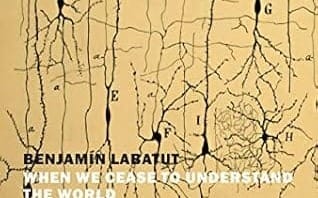
The Terrifying Cost of Genius: A Review of When We Cease to Understand the World
History often remembers scientific breakthroughs as moments of pure light, such as the apple falling, the "Eureka!" in the bathtub. But in Benjamín Labatut’s When We Cease to Understand the World, we are reminded that the light of discovery often casts a long, terrifying shadow.
History often remembers scientific breakthroughs as moments of pure light, such as the apple falling, the "Eureka!" in the bathtub. But in Benjamín Labatut’s When We Cease to Understand the World, we are reminded that the light of discovery often casts a long, terrifying shadow.
I recently finished this genre-bending work and found it offers a unique way to craft storytelling that sheds light on the brilliance of past minds. It is not quite a novel, not quite a history book, but a "non-fiction novel" that blurs the line between fact and fever dream.
The Human Side of Equations
Labatut focuses on the titans of 20th-century physics and mathematics—figures like Fritz Haber, Karl Schwarzschild, and Werner Heisenberg. In standard biographies, these men are often reduced to their outputs: an equation, a constant, a theory.
Labatut, however, weaves factual details with narrative imagination to present a complete, humanized view that is often lost when looking back on history's innovators. We see them not just as geniuses, but as individuals teetering on the edge of sanity, consumed by obsessions that threaten to devour them.
The High Price of Discovery
The book's core strength lies in how it handles the weight of unintended consequences. The narrative drives home the reality that invention and discovery often come at a high price.
The most poignant example is Fritz Haber. He is the man who saved billions from starvation by discovering how to pull nitrogen from the air to make fertilizer. Yet, he is also the father of chemical warfare, unleashing chlorine gas in the trenches of World War I. Labatut does not shy away from this duality; he forces us to sit with it. He allows the impact of these discoveries to land with the necessary force, reminding us that progress is rarely a straight, clean line.
The Verdict
When We Cease to Understand the World is a hypnotic masterpiece that challenges us to re-examine the foundations of our modern world. By illuminating the dark, chaotic heart of discovery, Labatut suggests that in our quest to understand the universe, we may inadvertently open doors we cannot close. For anyone interested in the history of science, the ethics of innovation, or simply a masterfully told story, this is essential reading.
Rating: 4/5 Stars
The Bottom Line: Labatut transforms the dry history of science into a haunting narrative about the frightening cost of genius. It is a brilliant reminder that the very inventions that save us are often capable of destroying us.